
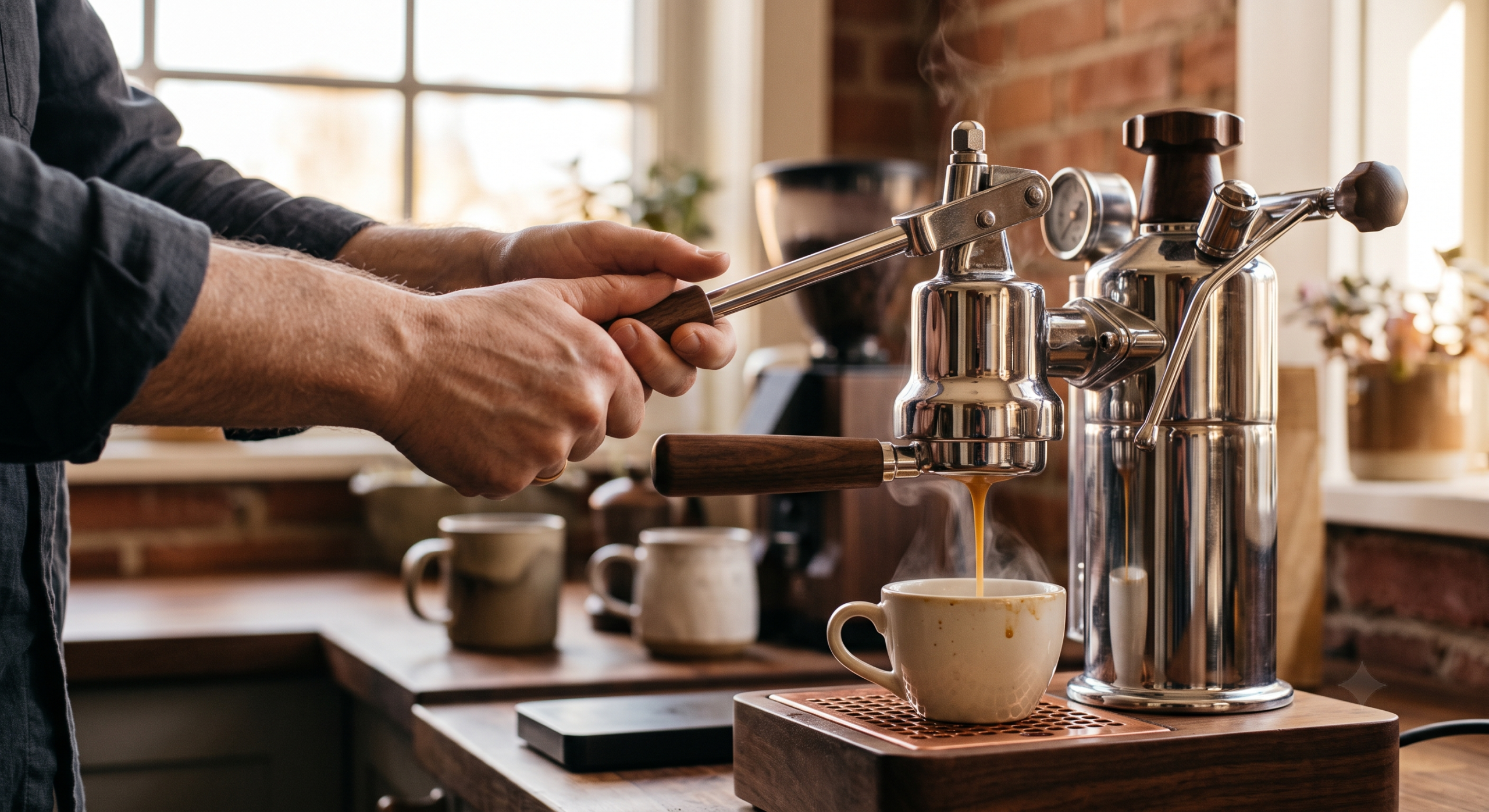
Manual Espresso Machines: A Complete Guide to Lever and Piston Brewing
A manual espresso machine uses your own hand instead of an electric pump to build the pressure that extracts espresso, usually through a lever or piston. Products2Buy, an online guide resource available worldwide, breaks this down without pushing any single product. Read the full guide to see which mechanism fits how you brew.
There’s a specific kind of coffee person who eventually gets tired of pressing a button. They’ve had good espresso from a machine that does all the work, and it’s fine — but it doesn’t feel like theirs. That’s usually the moment someone starts looking into a manual espresso machine, and it’s worth understanding exactly what you’re getting into before you buy one.
A manual espresso machine skips the electric pump entirely. Instead of a motor pushing water through the coffee, you do it yourself — pulling a lever, pressing a piston, or squeezing a handle, depending on the design. The water pressure that extracts your shot comes from your own hands, not a circuit board. That single difference changes almost everything about how the machine feels to use, what it can do, and who it’s actually good for.
How a Manual Espresso Machine Actually Works
Every espresso shot needs pressure to force hot water through tightly packed coffee grounds — usually somewhere around 9 bars. However, many home baristas today prefer a gentler 6 to 7 bars for a rounder, less bitter shot. An automatic machine creates that pressure with a pump. A manual machine creates it with you.
There are two main mechanisms behind that idea, and they behave very differently in your hands.
Lever Machines
A lever machine uses, unsurprisingly, a lever. You raise it to draw water into a small chamber, then push it back down to force that water through the coffee. There are two flavors of this:
Spring-piston lever machines — the style you’ll see on older, classic-looking machines like a vintage La Pavoni or an Olympia Cremina — use a loaded spring to apply pressure once you release the lever. The spring gives you a stable, repeatable pressure curve, but you can’t really change it mid-shot. What you get is what the spring gives you.
Direct lever machines, like the Flair 58, work differently. Here, the pressure you apply with your hand goes straight into the shot in real time. Push harder, and the pressure climbs. Ease off, and it drops. This is what people mean when they talk about pressure profiling — shaping the pressure curve throughout the shot to bring out different qualities in the coffee. It’s a genuinely different skill than automatic brewing, and it’s the main reason lever machines have such a dedicated following.
Piston-Driven Machines
The other major category skips the lever altogether and uses a simple piston or plunger you press down by hand — this is why people often call it a manual press espresso machine. The Cafelat Robot is probably the best-known example, along with the ROK Espresso. These tend to be smaller, simpler, and often cheaper than lever machines, and they give you the same direct control over pressure, just through a different physical motion.
A related but distinct design is the manual pump espresso machine, like the Handpresso — instead of pressing straight down, you work a small hand pump to build pressure before releasing it through the puck. It’s a slightly different motion than a press or a lever, but the same core idea: your hand supplies the pressure, not a motor.
For travel, the Wacaco Picopresso and the Handpresso both shrink this idea down into something genuinely portable — no electricity, no boiler, and small enough to fit in a bag, which is exactly what makes a portable manual espresso machine appealing for camping trips or hotel rooms.
Not to be confused with any of these: things like the AeroPress, which can produce a concentrated, espresso-like shot but doesn’t reach true espresso pressure and isn’t classified the same way by most coffee people.
Manual vs. Automatic Espresso Machine: What You’re Actually Trading
Whichever way you phrase the question — manual vs. automatic espresso machine, or automatic espresso machine vs. manual — the honest answer isn’t “one is better.” It’s a trade-off, and it’s worth being clear-eyed about it before you spend the money.
What you gain with manual:
- Full control over pressure and pre-infusion, which is the gentle early stage of a shot where water first saturates the coffee before full pressure kicks in — this reduces channeling, where water finds an easy path through the puck instead of extracting evenly
- Fewer electrical parts to break, which usually means these machines last a long time with basic care
- Portability — several of these machines need no electricity at all, which makes them genuinely useful for travel or off-grid mornings
- Often a lower price for genuinely good espresso than you’d pay for an equivalent automatic machine
What you give up:
- Speed — if you’re making shots for four people before work, this is not your machine
- Ease — there’s a real learning curve here, and your first few shots probably won’t be great
- Consistency — small variations in how hard you push or pull will show up in the cup, at least until you’ve built the muscle memory
What You Actually Need Alongside the Machine
This part matters more than people expect: a manual espresso machine is only as good as everything else in your setup.
A real burr grinder. This isn’t optional. Espresso needs a fine, consistent grind, and a blade grinder simply can’t produce it. Hand grinders like the Comandante or the 1Zpresso line are common pairings for lever and piston machines specifically because they’re built for the fine, even grind espresso demands, and because most manual machine owners already appreciate doing things by hand.
A gooseneck kettle. Water temperature really does matter — somewhere around 195 to 205°F (90–96°C) is the general target, and a gooseneck gives you the control to hit it and pour precisely.
A scale with a timer. You want to know your dose and your shot time, every time, so you can actually adjust intelligently instead of guessing.
A tamper, and ideally a WDT tool. WDT stands for Weiss Distribution Technique — basically stirring the grounds with fine needles before tamping to break up clumps. It sounds fussy, but it’s one of the simplest ways to prevent channeling.
A 58mm portafilter, if you can get one. This is the same basket size used on commercial café machines, and it’s what you’ll find on the Flair 58. Some smaller or older machines use a 51mm portafilter instead, which is still perfectly capable, just less standardized for accessories.
Which Manual Espresso Machine Fits You?
New to manual brewing and want to learn without a big investment? A simpler manual lever espresso machine or a piston design like the Cafelat Robot gives you the core experience without the highest price tag.
Traveling often, or short on counter space? The Wacaco Picopresso or a Handpresso covers this — both are genuinely portable manual espresso machines, with no electricity or boiler required.
Chasing the most traditional, hands-on ritual? An Italian manual espresso machine in the La Pavoni style — the Europiccola is the classic example — gives you that old-world feel, though be aware you’re managing temperature more actively than with an electrically-heated brew head like the Flair 58.
Want direct pressure control without the classic lever look? A direct piston design like the ROK or the Cafelat Robot puts that control in your hands in a more compact package.
If you’re comparing options directly, the short version usually comes down to this: the Flair line is the most flexible for learning pressure profiling, La Pavoni is the choice if you want heritage and looks alongside the ritual, the Cafelat Robot is the sturdiest and simplest press-style option, and the ROK, Wacaco Picopresso, or Handpresso make sense once portability matters more than café-level output.
A Basic Walkthrough of Pulling a Shot
- Heat your water to around 195–205°F.
- Grind fresh, aiming for a texture close to fine sand — noticeably finer than drip coffee.
- Dose and distribute your grounds evenly in the basket, using a WDT tool if you have one, then tamp firmly and level.
- Preheat the brew chamber if your machine calls for it, so you’re not losing heat into cold metal.
- Pull the shot, starting with a gentle pre-infusion to saturate the puck, then applying steady pressure, and easing off toward the end rather than stopping abruptly.
- Taste and adjust. A sour shot usually means the grind needs to be finer, or the dose needs adjusting; a bitter one often means the opposite, or that your water was too hot.
A Little History
Espresso itself goes back further than most people assume. In 1901, Luigi Bezzera filed a patent for an early espresso-brewing device, laying the groundwork for the machines that came after. Interestingly, the earliest espresso machines all relied on manual pressure, not far off from what a Flair or a Cafelat Robot asks of you today. In some ways, the modern manual espresso machine isn’t a step backward from automation — it’s a return to where the whole idea started.
Frequently Asked Questions
The Bottom Line
A manual espresso machine isn’t for everyone, and that’s kind of the point. If you want good espresso with zero effort, an automatic machine will always win. But if you want to actually understand what’s happening in the portafilter — pressure, pre-infusion, grind, all of it — a lever or piston machine gives you that in a way nothing else does.
There’s no single best manual espresso machine for every person — the right one depends on whether you value portability, heritage, simplicity, or pure control over the shot. Start with the right grinder, be patient with your first few shots, and the rest tends to follow.